Buy Spotify Saves: The One Signal That Is Actually an Input
Quick Answer
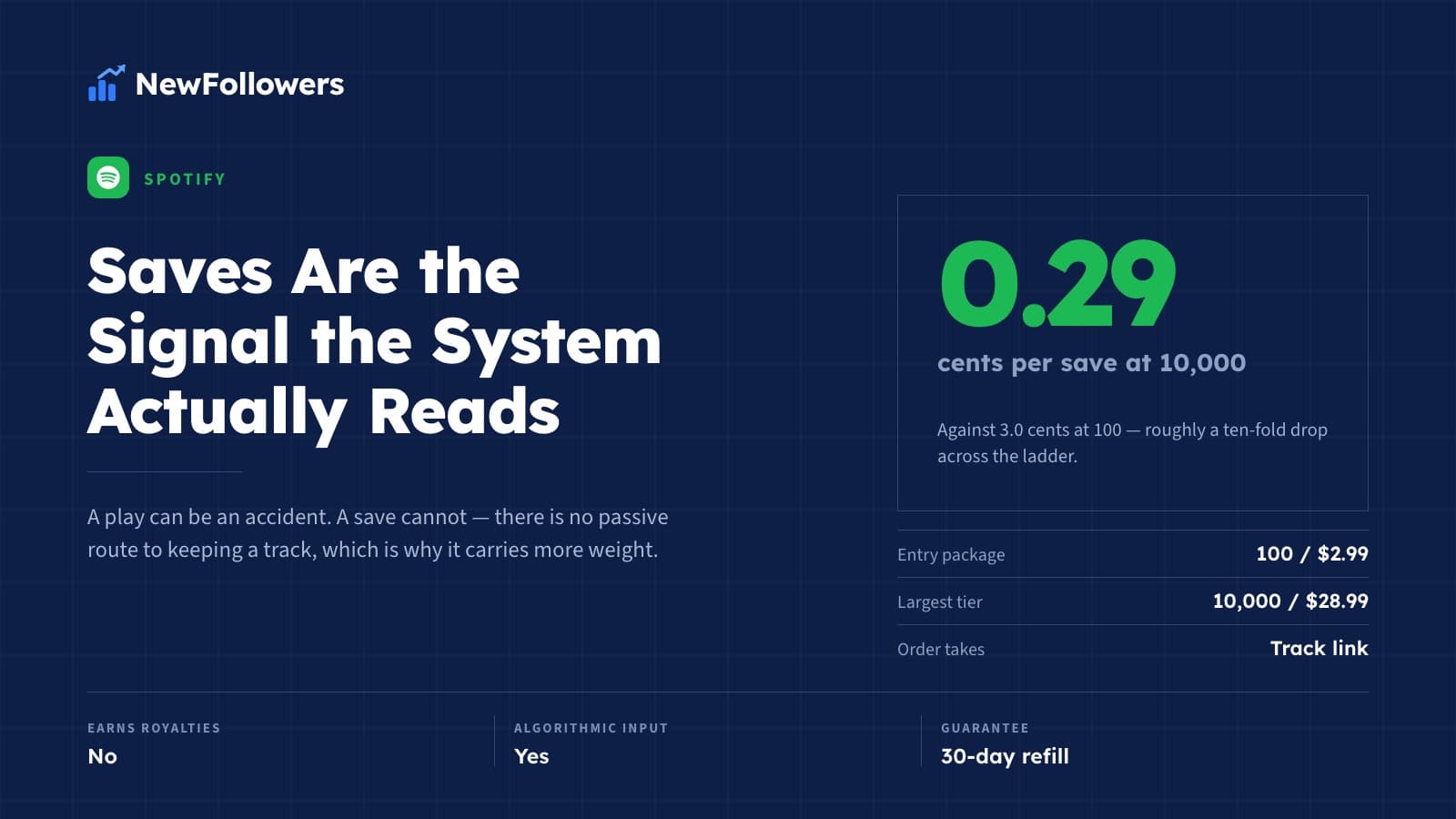
A save is a listener adding your track to their library, and it is one of the behavioural signals Spotify's recommendation systems actually consume — unlike a follower count, which is read by humans, not the algorithm. Saves run from $2.99 for 100 to $28.99 for 10,000, which is 3.0 cents each at the smallest tier and 0.29 cents at the largest. A save is a stronger signal than a play because it is a deliberate act with no reason to happen by accident.
Why a Save Outweighs a Play
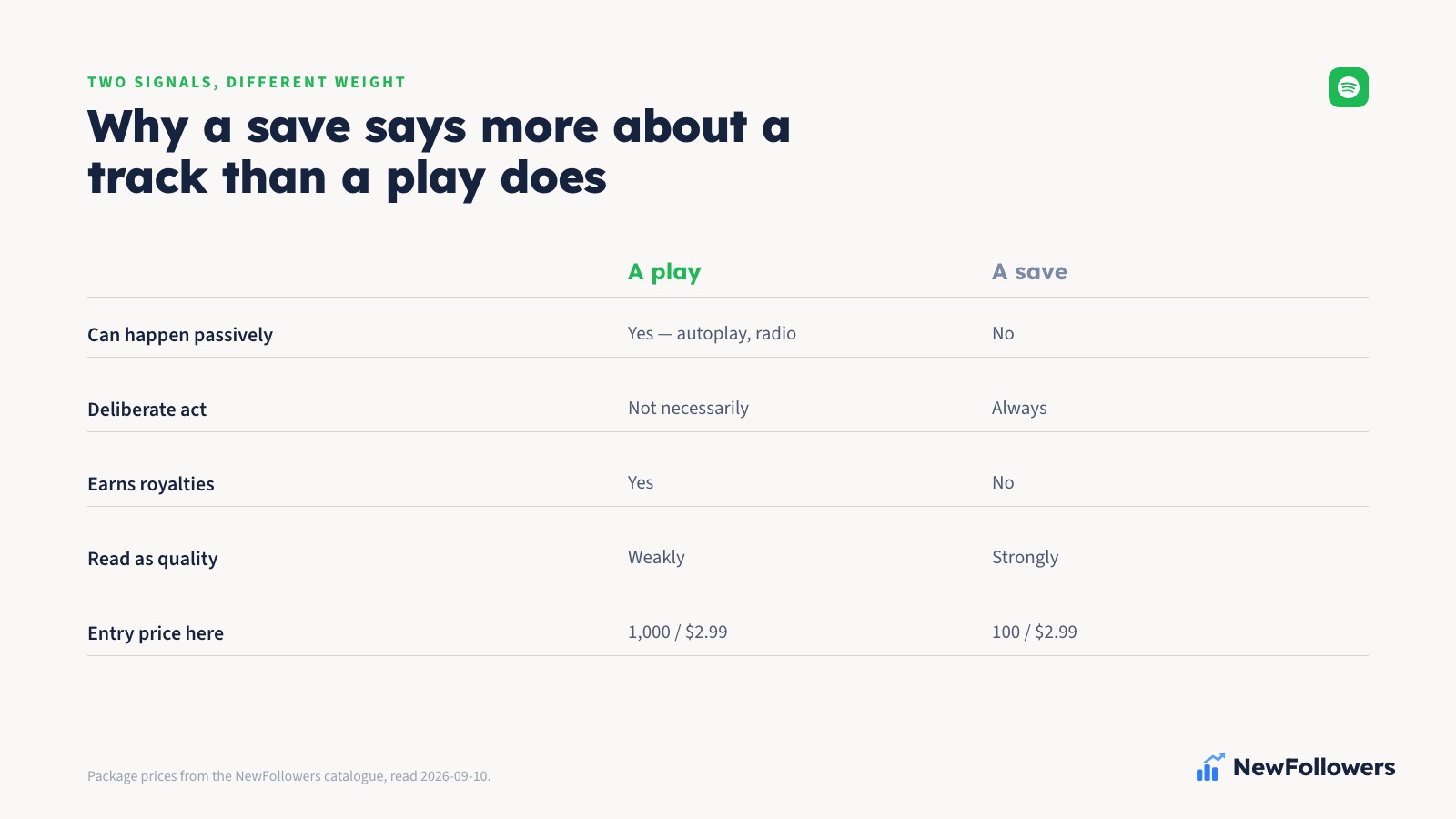
A play can be an accident. Autoplay reaches the end of a queue, a radio session drifts, a playlist runs in a kitchen for four hours. Spotify knows this, which is why raw play count is a weak quality signal on its own.
A save is not ambiguous. Someone heard the track, decided they wanted it again, and took an action to keep it. There is no passive path to a save. That deliberateness is exactly what makes it useful to a recommendation system trying to work out whether a track is worth showing to someone else.
This is the reason the plays package and this one are priced and used differently, and why buying plays to influence placement is the more common mistake.
What Saves Do Not Do
Worth being blunt, because this category oversells everything.
A save does not put you on Discover Weekly. Editorial and algorithmic placement weigh many behaviours together — completion rate, skip rate, repeat listening, source of the play, how the track performs with listeners who have never heard you. A save is one input among several, not a switch.
A save also does not generate royalties. A library add is not a stream. If the money is the point, the number you want is plays, and that is a separate purchase.
What a save reliably does is register the strongest single act of intent a listener can perform short of following you.
The Price Ladder, and What It Says
Saves cost $2.99 for 100, $5.99 for 500, $10.99 for 2,500 and $28.99 for 10,000. Per save that is 3.0 cents at 100 and 0.29 cents at 10,000 — about a ten-fold drop across the ladder.
That curve is worth reading. Cheap-at-volume pricing on a behavioural signal is a reason to be careful rather than greedy: 10,000 saves against 400 monthly listeners describes a track nobody is playing but everybody is keeping, which is not a shape that occurs naturally. The ratio between your numbers is more legible than any single number, and it is the thing a curator opening your profile notices first.
The Ratio That Gives It Away
Two profiles, same 10,000 saves.
The first has 60,000 plays and 4,000 monthly listeners. Saves are a fraction of plays, the listener base supports both, nothing is out of place.
The second has 900 plays. Every listener saved the track roughly eleven times, which is not a thing that can happen. It reads as bought to a human in about four seconds, and the systems that weigh behavioural signals against each other are not less capable than the human.
Buy the number that fits the profile you actually have. That usually means the smaller tier.
How It Is Delivered
We need the track link — the public Spotify URL for the song you want saved — and nothing else. Never a password, never Spotify for Artists access, which holds your royalty and audience data and has no role in a listener saving a track.
Delivery is gradual rather than instant, for the same reason it is gradual everywhere: a behavioural signal that arrives in one burst describes a pattern no real audience produces. Every package carries a 30-day refill guarantee if the count falls below what you ordered.
Save Rate, and Why It Is the Number to Watch
A raw save count means little on its own. The figure that describes whether a track is working is the save rate — saves divided by listeners — and you can compute it from numbers you already have.
A track played by 1,000 people and saved by 40 has a 4% save rate. The same track saved by 400 has 40%, which describes a completely different relationship between the song and the people hearing it.
There is no universal good number, because it varies enormously by genre and by how the listener arrived. A track discovered through a mood playlist collects fewer saves than one a fan sought out deliberately, and that is expected rather than a failure. What is useful is the trend across your own catalogue: which of your tracks people keep, and what those have in common. That is information no purchased number gives you, and it is the thing most artists never look at.
Buying saves distorts that measurement for the track you buy them on. Worth knowing before you buy them across everything you have released.
Timing: Release Week Is Not Magic
There is a persistent belief that signals in the first 24 or 48 hours decide a track's fate permanently. It is overstated.
What is true is that a release arrives with a burst of attention from people already following you, and how those people behave is a comparatively clean signal — they chose to listen, so their save and skip behaviour says something about the track rather than about the playlist it appeared in.
What is not true is that the window closes. Tracks find audiences months and years after release, and the systems keep reading behaviour the whole time. A catalogue track that suddenly starts collecting saves is not ignored because it is old.
The practical consequence: front-loading a purchase into release week is not the lever it is sold as, and a save pattern that spikes hard in 48 hours and then flatlines to nothing describes something no organic release does.
What the Numbers Look Like Together
Saves do not live alone, and the shape they make with your other figures is what a person or a system reads.
Healthy: plays exceed saves by a comfortable multiple, saves exceed followers on a track that outperformed, monthly listeners sit in a plausible relationship to plays.
Suspicious: saves approaching or exceeding plays. There is no route to saving a track you have not played, so this shape is arithmetically impossible for a real audience and is the single most common giveaway.
Also suspicious: a save count that is large and completely flat across every track in a catalogue. Real audiences prefer some songs to others. Uniformity is the fingerprint of a bulk purchase applied evenly.
Red Flags When Buying Spotify Signals
A request for Spotify for Artists access. That dashboard holds royalty and audience data. Saving a track requires the public song link and nothing else. This is the clearest reason to stop.
Instant delivery. Ten thousand saves inside a minute is not a service level; it is the pattern most likely to be read as automated.
Guaranteed playlist placement. No supplier controls Discover Weekly, Release Radar or editorial. Anyone selling it is selling something they do not have.
Saves priced below the band at small volume. Our ladder runs 3.0 cents each at 100 down to 0.29 cents at 10,000. Well under that at the small end means the cost is being covered another way.
A seller who will not say what a save is. If the product page uses "saves", "streams" and "plays" interchangeably, they are different things and the seller does not distinguish them. You will get whichever is cheapest to supply.
Where This Sits Against the Rest
If you want the number a curator or a scout reads when deciding whether you are worth their time, that is artist profile followers, and the followers guide covers that ladder.
If you want the number that decays and describes reach, that is monthly listeners, on its own rolling 28-day window.
If you want the number that pays, that is plays.
Saves are the one that speaks to the system rather than to a person. Choose on that basis, not on which is cheapest per unit.
Frequently Asked Questions
What is a Spotify save?
A listener adding your track to their library so they can return to it. It is a deliberate act — there is no passive or accidental route to a save, which is what makes it a stronger quality signal than a play.
Do saves actually affect Spotify's algorithm?
Saves are one of the behavioural signals Spotify's recommendation systems consume, alongside completion rate, skips and repeat listening. They are an input, not a switch — no single number places you on Discover Weekly.
How much do Spotify saves cost?
$2.99 for 100, $5.99 for 500, $10.99 for 2,500 and $28.99 for 10,000. That is 3.0 cents per save at the smallest tier and 0.29 cents at the largest, roughly a ten-fold drop across the ladder.
Do saves earn royalties?
No. A save is a library add, not a stream, and only streams pay. If revenue is the goal the relevant number is plays, which is a separate package.
How many saves should I buy?
Enough to fit the profile you already have. Saves that vastly outnumber your plays describe a track nobody is listening to but everybody is keeping, which does not occur naturally and reads as bought to anyone who opens your profile.
What do you need to deliver saves?
The public Spotify link to the track. Never a password and never Spotify for Artists access — that holds your royalty and audience data and has no role in a listener saving a song.
Ready to Grow Your Social Media?
Real followers, instant delivery, 30-day refill guarantee. Pick your platform: